
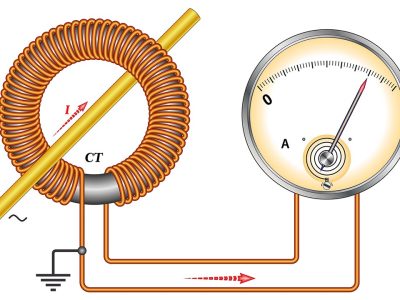
In this article we explore the dangers of an Open-Circuited Current Transformer (CT) and discuss Crest, RMS and Peak Voltages. A Current Transformer (CT) is an essential device in electrical systems used in Solar Photovoltaic (PV), Electric Vehicle Charging (EV) and Battery Storage and is used to measure higher currents by producing a smaller, proportional current in its secondary winding.
A Current Transfomer is widely used in power distribution, protection relays, metering applications, solar pv, ev chargers and battery storage systems. One of the most important safety rules when working with CTs is never to leave the secondary circuit open while the primary current is flowing. If this happens, it can lead to dangerously high voltages that pose serious risks such as electric shock, insulation failure, equipment damage, or even fire.
During EICRs (Electrical Installation Condition Reports) and fault-finding on Solar PV, EV, and Battery Installations done by other installers, we often find that most (if not all) electricians, installers and even some manufacturers technical departments simply do not understand the dangers and risks associated with a Current Transformer (CT). We frequently see CT wires hanging dangerously, the use of gel crimps (rated at 50V or below) and the use of easy to disconnect WAGOs, all without the proper protection required, making them vulnerable to damage or becoming an open circuit, which is a shock and fire hazard.
1. Why Does an Open Circuit in a Current Transformer Cause High Voltage:
Under normal conditions, the CT secondary winding carries a current proportional to the primary current, flowing through a connected load or measuring device. This current flow ensures the magnetic core of the CT stays within its designed limits, maintaining proper operation.
However, if the secondary circuit is opened:
- There is no path for current to flow.
- The magnetic field inside the CT core builds up excessively, leading to core saturation.
- When the primary current crosses zero (changes direction), the magnetic flux in the core collapses rapidly.
- This sudden change induces extremely high voltages across the secondary winding, which can be thousands of volts.
2. Understanding Crest and Peak Voltages:
- Peak Voltage: The highest voltage reached in a single AC cycle.
- Crest Voltage: Another term for peak voltage, often used when discussing AC waveforms.
3. Why Are High Crest Voltages Dangerous:
- Electric Shock Hazard: High voltages at the CT terminals can cause severe electric shock if touched.
- Insulation Breakdown: Most CTs have insulation rated for normal operation. If the crest voltage exceeds this limit, the insulation can fail, leading to short circuits and permanent damage.
- Fire Risk: Extremely high voltages can cause electrical arcing, which may ignite surrounding materials.
- Equipment Damage: Protection relays, meters, and other connected devices can be damaged by excessive voltage spikes.
4. Why Can’t Crest and Peak Voltages Be Measured Without an Oscilloscope:
Measuring the dangerous crest voltages in an open-circuited CT is difficult with a standard voltmeter or multimeter because:
- Multimeters Measure Average (RMS) Voltage, Not Peaks. Most digital or analog voltmeters only measure RMS (Root Mean Square) voltage, which is the equivalent steady DC voltage that would produce the same heating effect. The dangerous transient peak voltages that occur in an open-circuited CT are much higher than the RMS value but exist only for very short durations.
- Transient Spikes Happen Too Fast for a Multimeter to Detect. The high-voltage spikes in an open CT last for only microseconds or milliseconds, much shorter than the response time of a standard voltmeter. A voltmeter might display a normal or low reading while the actual peak voltage could be thousands of volts.
- Oscilloscopes Capture Fast Voltage Changes in Real-Time. Only an oscilloscope can properly display the crest voltages because it samples voltage continuously at high speeds. An oscilloscope can show the waveform in detail, including sharp spikes and momentary high-voltage transients that a multimeter would miss.
- Danger of Direct Measurement. Even if a voltmeter could measure the voltage, connecting it directly to an open-circuited CT secondary could be extremely dangerous, as the high voltage could damage the meter or pose a risk of electric shock. Oscilloscopes used for such measurements must be properly rated for high voltage and should be used with appropriate high-voltage probes and isolation techniques.
5. Factors Affecting Open Circuit Voltage Magnitude:
Several factors determine how high the voltage can rise if a CT secondary is open-circuited.
- CT Turns Ratio: A higher turns ratio means a greater risk of high secondary voltage.
- Core Material and Design: Some core materials saturate more easily than others, influencing voltage buildup.
- Primary Current Magnitude: Higher primary current increases the potential for dangerous voltage levels.
6. How to Prevent Dangerous Voltages in a Current Transformer:
- Never Leave the Current Transformer (CT) Secondary Open. Always connect the secondary to a load (meter, relay) or short-circuit it when not in use.
- If a CT is disconnected, its secondary terminals should be shorted using a shorting block or terminal to safely dissipate energy. Always do this with no load applied through the CT.
- Regular Maintenance: Frequently inspect CT wiring and connections to ensure they are secure and free from potential faults.
Calculations to show the dangerous voltages that can occur in a Current Transformer (CT) if open circuited under load:
- We Assume the following for this example:
- Turns ratio: N=2,000,000:1N
- Primary current: Assume 1 A (can be adjusted as needed)
- Magnetizing inductance: Typically in the range of 1 H to 100 H for high-ratio CTs
- Frequency: 50 Hz (standard UK power system frequency)
Step 1: Induced Voltage Formula:

Step 2: Estimation with Sample Values:
Let’s assume:
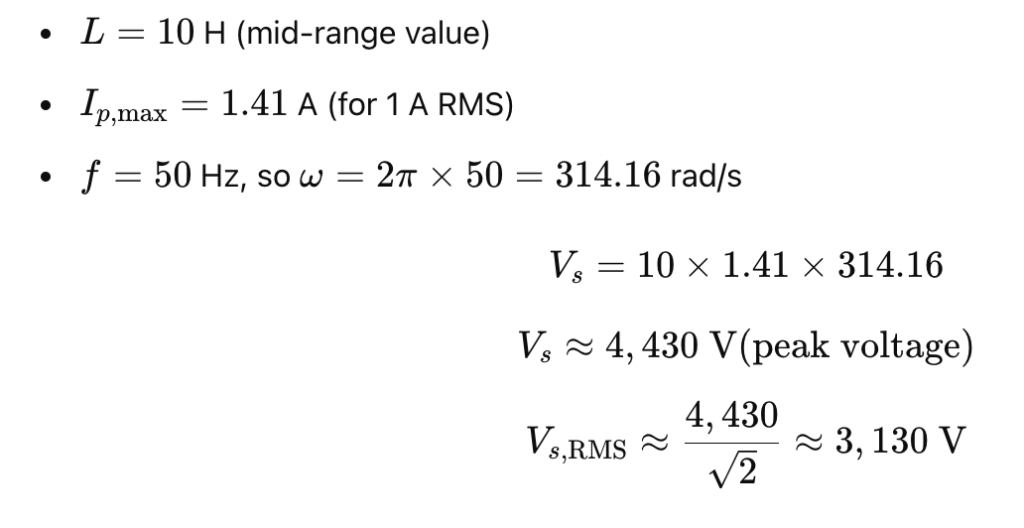
Therefore in the above example with a 1 amp primary current in the open circuit CT, the secondary voltage can reach around 3.1 kV RMS (or 4.4 kV peak). If the primary current increases, this voltage scales proportionally, making it extremely dangerous!
FOR ANY ENQUIRIES, NO OBLIGATION QUOTE OR TO DISCUSS A PROJECT THEN
please click here to contact us